#writing #essay
On Resiliency
all life is a process of breaking down
—F. Scott Fitzgerald, The Crack Up.
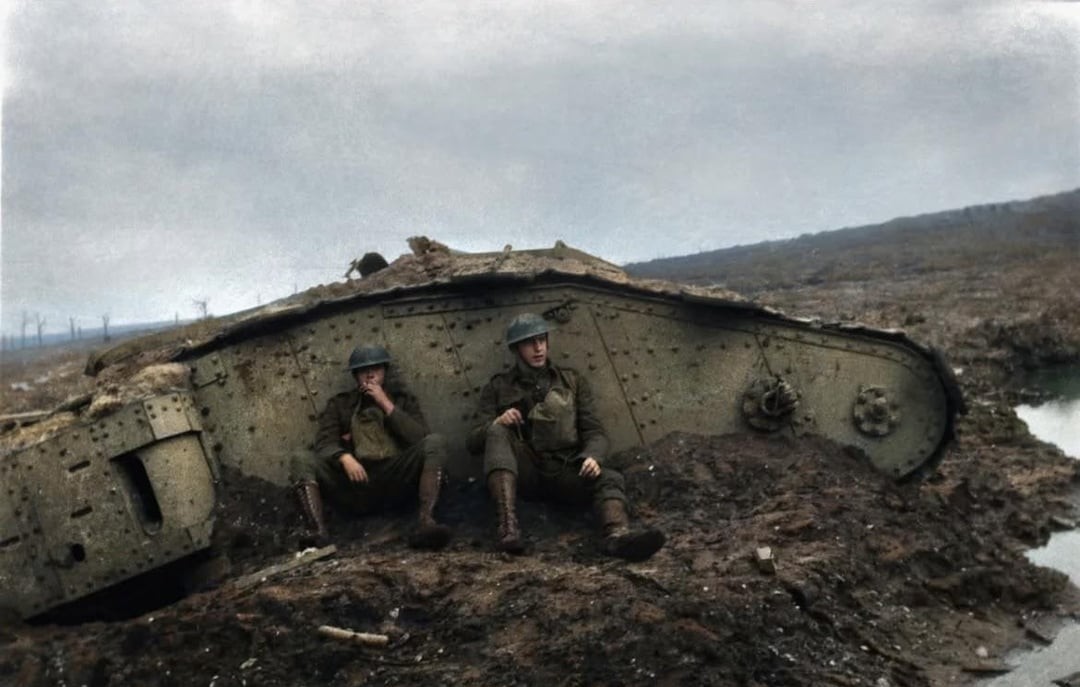 Photograph circa 1917-1918, Unknown Photographer. Colourized by Julius Blackman
The urge to write like this is especially motivated by extreme and quintessential emotion. It comes directly from the past few days, where I have suffered continuously with poison oak rashes over much of my body, marking me red and splotchy like a Pollock. It comes from the hours upon days I have spent—alone—sitting in the emergency room waiting for a Doctor or nurse to bring me into the grace of their care, only to tell me that what steroids I have been prescribed will do their work, that I am simply expected to endure the torment according to their timescale. It comes from the times I have spent in utter desolation huddled up on the shower floor, scarcely able to consider a thought or rile myself to any sort of motivation, good or bad. It comes from the moments of anxiety and turmoil endured over years, which weave themselves through my every atom of being like a great weight, serving only to resist my every action towards forward movement.
In such cases of concentrated hardship, I feel a great urge to write. An absolute necessity to bottle up this feeling into a coherent message, to part the fog from my mind and state clearly: “life is hard. And it is not only hard, but it is cruel”. Yes, this is its defining characteristic. Life is cruel. Good riddance!
And of course, how could it not be? I could so obviously make the case. All my life has been marred by cruelty: I was brought into this world with medical conditions of chronic and debilitating verities; If I am lucky enough to avoid the worst of their afflictions (as I have so far), I am almost certainly guaranteed to have my ticket punched by the assistance of their neighboring symptoms. Past childhood and into adolescence there is much of the same. There’s the enduring of a fractured home, a constant ripping-in-two, by parties I’d grown to love when they could only be one. There is the angst of the pubescent period, which is considered only to the extent that we all ought to pass through it expediently, like a trial which tradition says must be succeeded. Then there is college, where I find myself in a vicious cycle of want, failure to act, and a regular falling short-of-the-mark, which does little in my mind but to stoke feelings of frustration and confusion.
Time and time again I have suffered, and I believe deep down that by axiom, I am guaranteed to suffer fourfold for any pleasure that might chance to accompany my existence. It is not a thought I declare too regularly or allow myself to formalize for fear of becoming systematically pessimistic, but it hearkens to a general way of endurance that I do take pride in orienting with. Perhaps it is inherited from my British blood: A people who by their character are entrenched in the stereotype of stoic endurance with understatement. Lest we forget the mantra, invoked by all who bear the stiff upper lip:
Keep Calm and Carry On
And yet returning to my original declaration, I find that if I allow myself to think calmly, to survey the full logic of what I know or think to be true, I cannot in good conscience proceed with cruelty as a universal factor over my being. Life is not cruel. It simply cannot be. Yes life is hard. It will come as no great surprise to anyone having lived—moreso for those who have lived at length and at depth—that life can sometimes be hard. Hardships come and go. Like ocean waves, they approach with torrential roar, or else a slow rise. Arriving, hardship stays awhile on a timeline of its own. Then as quickly as it comes, it departs with haste. Where does it go? When will it return? That’s a question for the Stochastics, or the Karmics. God willing, it’ll stay gone forever. Good riddance!
So yes, life can be hard, but it is not cruel. For life to be cruel, its miseries would need to be delivered in purpose thereof. In support of a cruel life, one might picture a Demon, unkind and unpleasant, whose sole purpose is to operate a little red button which delivers a torment with every push, simply because it makes him happy. I can picture him now, pushing that button with a conniving smile. He’s quite adept at it after awhile and to no surprise; you’d get good at anything if you spent your life pursuing it. But for him it’s not enough simply to punish. He’d deliver his hardships with narrative stress, to highlight a failure to perform on the things that mattered most. His quota of handicaps would be delivered when they impacted you the most, and when the irony of their complications are most pronounced, he’d concert great displays of action in accord with your desires to maximize awareness of your failures. With surgeon-like precision he would move the pieces of the world, so that their happenings were tantamount to ensuring you a holistic experience of ever-pervading turmoil. Maybe he’d even win an award: Demon of the month—going on three years now—which he’d proudly display on his desk next to his drinking bird and Newtonian cradle.
But the longer I am alive, the more opportunities I have had to sample of its flavours. And I find my hypothesis continuously reinforced that life is not altogether concentrated in moments of hardship, nor in pleasure. And it is certainly not designed or driven by any anthropomorphic being whose sole aim is to ensure your maximum and gracefully enacted suffering. For every hardship, there is a reason. In my life, and especially at times like this, when I have been drawn to pour out my frustrations into something definite, I find myself again and again slowed by the brakes of reason back into the boring conclusions of understanding. This, it would seem, is the fault of the essay as well: It’s impetus may be spurred on by spontaneous feelings of discomfort, which wills one to write, and yet the process of its construction—which synergizes such motivations with contemplation—oftentimes finds the emotions well understood and tranquilized and yet not altogether resolved. Perhaps I should try poetry instead.
There are reasons for everything, and I mean that in the most practical sense without stepping foolishly into the realm of teleology. I mean to say that for every fault you have suffered and will suffer, there is an apt reason for it that may or may not be beyond your control, but that is likely well within your understanding. In my case, I have determined with adequate confidence that my major malfunction lies not in a vacancy of effort, but in a critical mismatch in its proper apportionment. It is no wonder that I find my academic proceedings falling short time and time again, since I have yet to seriously attempt a regular habit of studying over the course of weeks and months as opposed to cramming in the final waning hours of night before the tests themselves. In regards to personal pursuits, I have historically given little thought as to my mortal constraints. I pile on pursuits like they’re free, giving myself goals with a smirk that says I embody their triumphs simply by taking them on. And in doing so, am I wrong? The human brain—and this is perhaps its greatest fault—is capable of total actualization concerning any topic. We have broken our natural order, domesticated the surface and the sea, and walked with primate action on the surface of the moon. If it were available to us, I see no reason that through human eyes we could not glimpse and actualize the true and full nature of it all. With this in mind, is it any wonder that I should desire without compromise? Should I not, with no hint of exaggeration, desire the world?
But of course, I am mortal. And things must be done with this constraint in mind. I ought to sleep, and eat. To exercise my body, mind, and soul, and to pay bills and hold down a job. If there is such a thing as Heaven, or Nirvana, or a total actualization of everything that ought to be important, it only matters inasmuch as a path exists between here and there. And if no path exists, we can’t come to the conclusion that this is cruel. It is simply a part of the great Donnée, by which all action must now proceed. The things I wish to do only matter if I can achieve them. And when I attempt the world all at once, my failures serve not as a marker of some great tragedy, but as a patterned message that maybe, just once, I ought to do things one at a time.
But the ideal reader ought to consider this conclusion as a great slap in the face left as is. Any good piece of writing ought to fuse two things: It ought to be undoubtedly true, and it ought to be provoking. Yes, things happen for a reason. This is undoubtedly true, and we all would likely fare better by operating in tandem with reality than by pushing against it. But what salve does this serve to my former self, who only hours prior to the writing of this essay sat in excruciation and fatigue for days, only to be at its resolution mostly worse off and still obligated to take on life as it continues? Is the takeaway that I simply shouldn’t’ve hiked where the urushiol grows? Pah! What nourishment does the knowledge of drought provide to the farmer who now suffers its actualizations? Or global politics to the refugee now lined up before the trains? There is nothing provoking about this conclusion, no great energy of action that we can readily derive from its embodiment. And? So what? It seems to me that life, sometimes, is just a slap in the face—a kick in the teeth. Nothing more, and nothing less. Good riddance.