#essay
The Four Horsemen
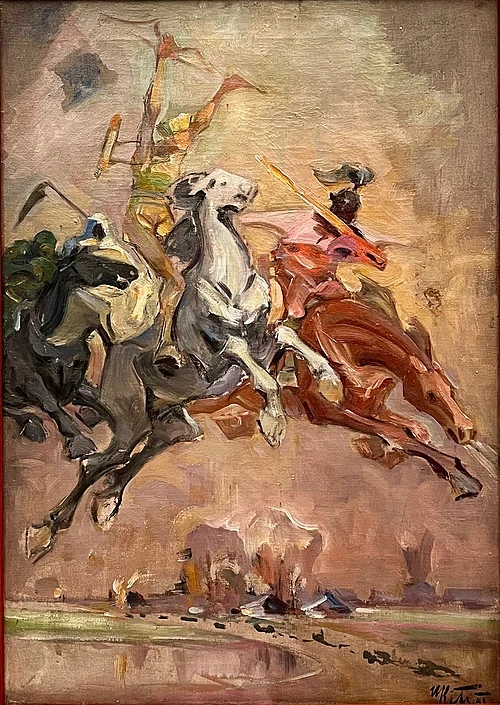 Marcin Kitz, Four Horsemen of the Apocalypse
Most people are familiar with the traditional four horsemen of the apocalypse. The horsemen come from the book of revelation, and are considered the harbingers of the end times. They were inspired by a causal chain of death which to many throughout history was a very real threat. With the first seal broken comes the conquest of foreigners who burned villages and salted lands in their wake. The second brings war. Internal strife came to lessen one’s fellow man, to turn neighbor into burglar and what’s yours into mine. With the third, the breakdown of society destroyed commerce, trade, and reliable supplies of medicine and food. When the fourth seal is broken, Death—composed of all the elements—annihilated those who remained. These fears were very real to people throughout history, and still loom over the disadvantaged and impoverished today. Yet we do not fear the Apocalypse like we used to1. The great horsemen exist merely in the abstract: as storytelling devices, symbolic characters, and myth.
But if you listen closely, the clopping of hooves from a quadric coeval cohort approaches nearer. They are here to pray on the unwary and the unwitted. The seals have already been broken—behold! You would do well to read below, lest’ you care to tend in mortal peril…
The White Horse: Addiction
Then I saw when the Lamb broke one of the seven seals, and I heard one of the four living creatures saying as with a voice of thunder, “Come!” I looked, and behold, a white horse, and he who sat on it had a bow; and a crown was given to him, and he went out conquering and to conquer.
- Revelation 6:1-2
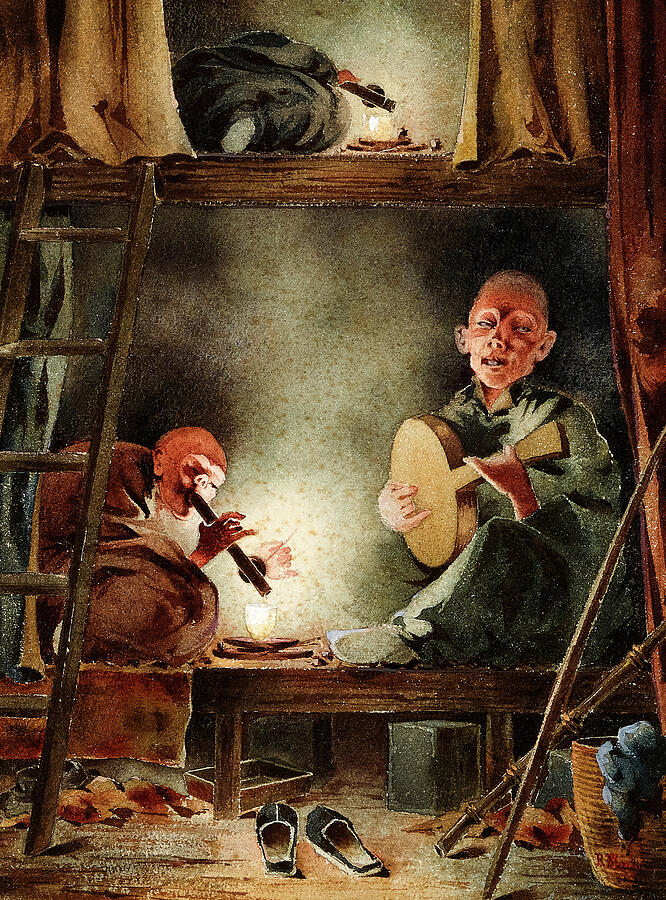 The Opium Den, Robert F. Blum
With the breaking of the first seal came the white horse, which traditionally stood for conquest. But this is not our focus. In modern times, the first great woe is addiction.
I will clarify here that the horsemen of revelation do not stand apart from each other. Each follows one after another, and symbolizes a specific state in the collapse of civilization. The white horse brings foreign conquest. Next with the red horse comes war—or more specifically civil war—as the nation fails to hold itself together against internal forces. The black horse brings the ensuing collapse of trade, of the economy, etc. And finally is death himself on a pale horse, who cleans the residue with the forces of nature, wild beasts, and meager bloodguilt. My mapping of modern ills upon the horsemen does not relate to this metaphor. He who suffers from the first horse will not necessarily suffer from the latter. In that sense, the modern horsemen are more like a spectrum of possible sufferings that can befall man. And despite my ordering, none of these are necessarily better or worse than the other. They all suck, and you’d do well to avoid them.
Nevertheless, addiction is a lot like war. Upon the internal domain comes the warring banners of an external force. Whether it be marijuana, cocaine, alcohol, or even caffeine, each substance crosses the threshold of your body and goes to work on it. Molecules bind to receptors, flood your brain with neurotransmitters, or block pathways and soothe pain. Each one acts differently. Some are weak, like advil. Some are strong, like fentanyl. Some enjoy strong cultural ties like LSD, which was largely responsible for the early hippie movement in the 1960s. Others remain known but presently mundane, like alcohol which some people do not even consider a drug2.
The worst part about drugs (or to some, the best) is that they do undeniably work. People wouldn’t take them with the voracity they do if they were tantamount to sugar pills. Drugs activate or inhibit the same receptors your body uses for regular cognition. Alcohol operates on the central nervous system for example, where it suppresses electrical activity. This helps ‘quiet’ the parts of the brain that regulate stress, anxiety, and inhibition, which is why many people use it to be more outgoing and sociable. Heroin, an opiate3, operates on the opioid receptors, which leads to a flooding of endorphins and an absolute feeling of euphoria. People often describe it as an overwhelming feeling of bliss, or like being wrapped in a warm blanket.
The body works really hard however to maintain what is called homeostasis
The Red Horse: Relationships
When He broke the second seal, I heard the second living creature saying, “Come”. And another, a red horse, went out; and to him who sat on it, it was granted to take peace from Earth, and that men would slay one another; and a great sword was given to him.
- Revelation 6:3-4
It is fitting that the horse of civil war or internal strife be compared to relationships, the next great woe. Specifically, we are talking about bad relationships. And a bad relationship is a lot like war.
Another clarification. While there are many modern ills to choose from, the four described here are of a specific nature. They are what I would call foundational ills. Your relationship to these woes describes the foundation with which you then go on to experience your life, meaning that a life without any of them is not guaranteed to be good, but a life with any of them is near guaranteed to be disadvantaged. For example, an individual who has left a bad relationship is certainly better off than before, but they are not necessarily happy now that they are alone. To be free of any of these sufferings does not guarantee you peace, only a neutral base free of certain suffering.
A bad relationship is not necessarily bad in and of itself. A bad relationship—much like a bad experience—can serve as feedback to orient an individual to a proper course of action. While burning your hand on a hot stove is not pleasant, the experience serves to keep you from doing it again. Likewise, a bad relationship can serve to show you your own flaws. It can show you the values you would like to have, what you need to work on, what a relationship requires. It can also show you the flaws of others: what you want in a partner, what you think you deserve.
Returning to the hot stove experience,
The Black Horse: Debt
When He broke the third seal, I heard the third living creature saying, “Come”. I looked, and behold, a black horse; and he who sat on it had a pair of scales in his hand. And I heard something like a voice in the center of the four living creatures saying, “A quart of wheat for a denarius, and three quarts of barley for a denarius; but do not damage the oil and the wine”.
- Revelation 6:5-6
Famine
The Pale Horse: Illness
When the Lamb opened the fourth seal, I heard the voice of the fourth living creature say, “Come!” I looked, and there before me was a pale horse! Its rider was named Death, and Hades was following close behind him. They were given power over a fourth of the earth to kill by sword, famine and plague, and by the wild beasts of the earth.
- Revelation 6:7-8
Death
Footnotes
-
You were expecting something political and nihilistic here, weren’t you? ↩
-
Think how often you hear the phrase, “Drugs and Alcohol”. See: “I don’t do drugs, I just drink”, Australia’s, “Alcohol and Drug Foundation”, etc. Alcohol is first and foremost a drug. But it is often divorced from the colloquial meaning of drugs due to its cultural and legal status in most countries. ↩
-
An opiate is a drug manufactured primarily from the poppy plant (See Heroin, Morphine, Opium). An opioid is a superset of opiates, that include drugs manufactured synthetically but which still operate on opioid receptors (See Fentanyl, Oxycodone, Methadone). ↩